Written by Aaron Barnes
Modern Movements
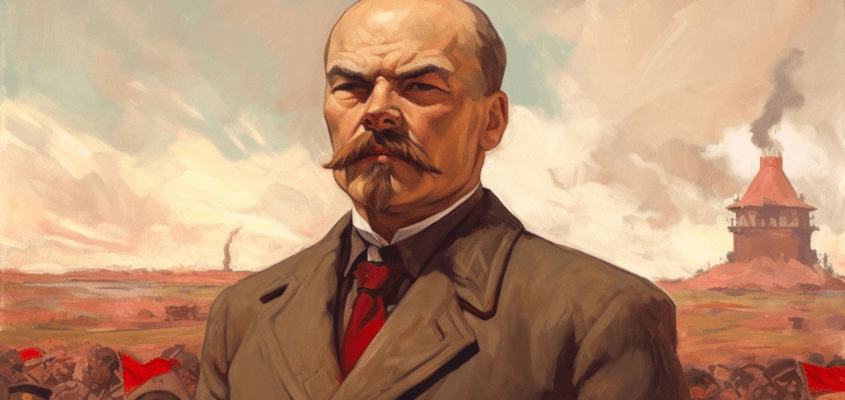
According to, Why Marx Was Right By Professor Terry Eagleton, socialism is again on the rise in the West. As recently as 2008, when the Great Recession occurred, the public noticed a shift in ideology and blame towards the 1% and the ultra-wealthy. Protests like the Yellow Vests in Paris, or the Occupy Wall Street in the USA are symptoms of growing discomfort and animosity between the working class and the very wealthy. With modern lobbyists dumping millions of dollars into the political system, one can agree with points Lenin raises, as extreme they may be, modern society feels the stasis.
Lenin and Marxist Critique on Democratic Republics
Lenin believes that the rich will do what they can to manipulate a democracy so that it is more representative of a few rather than the majority. As a Marxist he believes the proletariat are “wage-slaves” who “cannot be bothered by politics” since they are working so hard for so little to survive. The following is an excerpt taken from The Economic Basis for the Withering State, in the Communist Manifesto, “But this democracy is always hemmed in by the narrow limits set by capitalist exploitation, and consequently always remains, in effect, a democracy for the minority, only for the propertied classes, only for the rich. Freedom in capitalist society always remains about the same as it was in the ancient Greek republics: freedom for the slave-owners.” Lenin criticized democracy as a whole, but further cites Marx to criticize republican democracy as well saying
“once every so often the working poor get to select one of the rich to govern on behalf of them.”
this was a critique on the fact that working class citizens are not equally represented or given an opportunity to voice their opinions (and their constituent’s) in parliaments of democracy and republics. The “state” as currently described by Lenin, is a system of oppression put in place to keep lower classes producing for individuals rather than themselves. This excerpt explains the context of Lenin’s rationale, “and it is compatible with the extension of democracy to such an overwhelming majority of the population that the need for a special machine of suppression will begin to disappear.” When Lenin says, “the state will wither away” he is describing the process through which revolution occurs. Lenin believes that the proletariat will need to actively rise up with arms to depose the bourgeoisie, a Marxist principle, in order to begin moving towards the levels of a utopian communist society.
Leninist View of Transitioning Government Structure
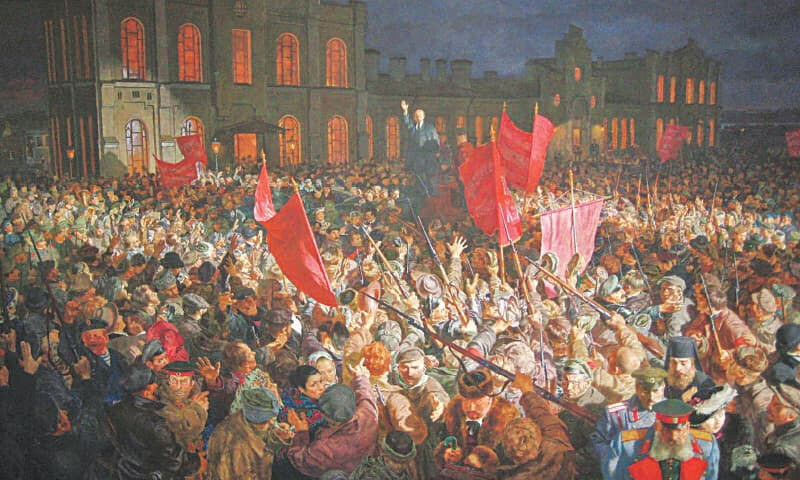
The transition period is known as “the dictatorship of the proletariat”, this is a state in itself to ensure that the transition through the stages are taking place and that production, wealth and representation is being spread evenly throughout the populace. The lower phases of communist society seem to be bloody and chaotic; therefore, a state different from a democratic state is put in place. Once this transition begins to take effect, a “higher level” of communist society comes into play.
In order for the state to completely wither away, society will begin to function as a communist utopia, as described by Lenin:
“The state will be able to wither away completely when society adopts the rule: “From each according to his ability, to each according to his needs. I.e. when people have become so accustomed to observing the fundamental rules of social intercourse and when their labor has become so productive that they will voluntarily work according to their ability.”
To expect people to either act this way or become accustomed to this new form of governance (or non-governance) seems counterintuitive to human nature; or as an idea, it seems the transition to utopia requires much violence, bloodshed, and an oppressive, unlimited transition period.
Final Thoughts
In conclusion, Lenin believes democracy has a dualistic nature to it. On one hand, democracy means equality and every man should be equal and free; but on the other, democracy means oppression and misrepresentation. The state of democracy as we know it is interpreted as oppressive, but the democracy that Lenin and communist utopians strive for is the freedom of equality and to work as much or as little as you want and need. In order to achieve the communist utopian, the systematic withering away of the current state needs to occur. This starts with armed revolt, transitions to a proletariat dictatorship, and ends with a higher level communist society with no need for an oppressive state.
 Timeless Teachings
Leave a comment