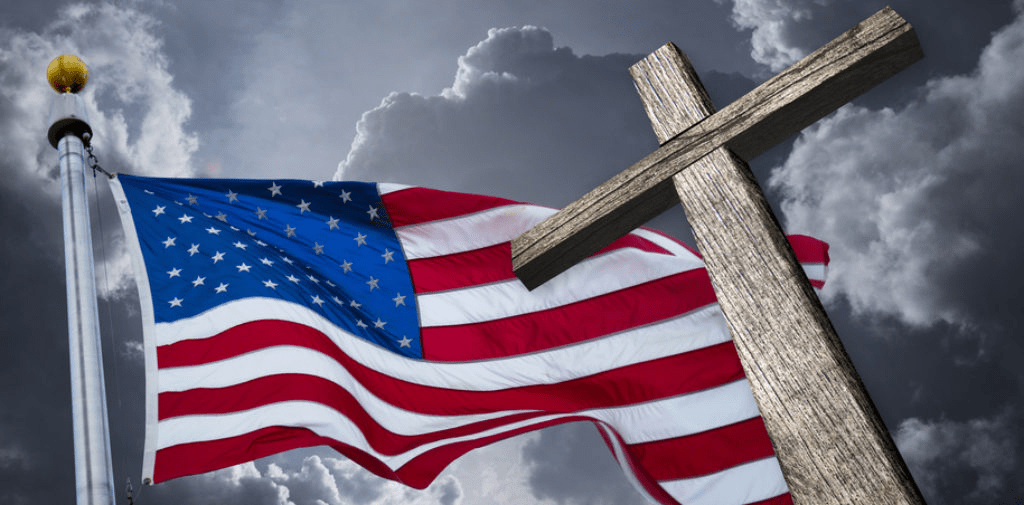
Christian Nationalism is a cultural and political ideology that asserts the United States was founded as a distinctively Christian nation and demands that its laws, public institutions, and national identity be scrubbed of pluralism to reflect a specific brand of conservative Christian morality. At its core, the movement believes that the country’s legal and social framework holds a unique covenant with God, and that true American identity is inseparable from Christian values. Proponents argue that the separation of church and state is a historical fabrication, claiming instead that Christianity should hold a privileged, authoritative position in the public square. By merging religious fidelity with national patriotism, the ideology seeks to transform the government from a neutral arbiter of rights into an active defender of biblical principles as they interpret them.
Origins and Goals of Christian Nationalism
While this blending of cross and flag feels modern, its structural roots trace back to the early 19th century through groups like the National Reform Association, which unsuccessfully lobbied during the Civil War to amend the Constitution to explicitly acknowledge Jesus Christ. Historically, however, early American religious political movements focused primarily on moral crusades such as temperance, like Carry Nation, or blue laws, where states restrict certain commercial activities on the Sabbath. Most of these movements principally accepted the constitutional framework of a pluralistic democracy, viewing America as a “Christian nation” in culture rather than a strict theocracy. In contrast, modern Christian Nationalism has evolved into a systemic and institutional pursuit of power. Today’s movement differs from its predecessors by shifting away from mere cultural influence toward capturing the machinery of the state, rejecting the very premise of a pluralistic society in favor of achieving dominion over secular institutions.

To realize this vision in modern America, Christian Nationalists utilize a coordinated, multi-pronged political strategy aimed at institutional capture, some tactics of which are outlined in Project 2025. Rather than relying solely on grassroots church revivals, leaders within the movement and some Evangelicals are deeply invested in “Seven Mountain Dominionism“, a theology mandating that Christians take control of the seven primary spheres of societal influence: government, education, media, family, business, science, and the arts. Today, this manifests as tactical campaigns to pass state-level legislation restricting reproductive rights and discrimination protections, alongside concerted efforts to defund public education in favor of taxpayer-funded religious schooling. Furthermore, the strategy leans heavily on judicial appointments, reshaping federal and local courts with judges sympathetic to their cause.
Founding Father’s Beliefs
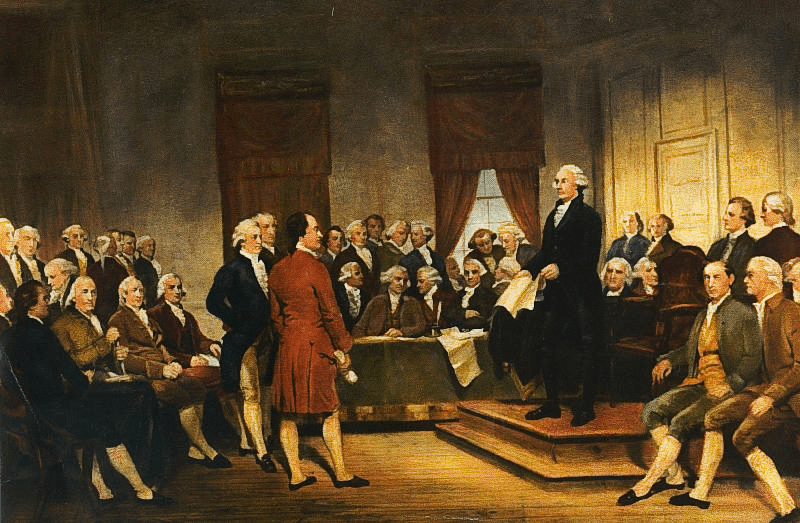
This theological agenda stands in direct conflict with the explicitly secular vision designed by the country’s founders, who were deeply cautious of blending religious dogma with state power. Thomas Jefferson famously promised that the First Amendment built a “wall of separation between Church & State” in his 1802 Letter to the Danbury Baptists, and later anchored this view in a letter to Jared Sparks (November 4, 1820):
“No man shall be compelled to frequent or support any religious worship, place, or ministry whatsoever, nor shall be enforced, restrained, molested, or burthened in his body or goods, nor shall otherwise suffer, on account of his religious opinions or belief; but that all men shall be free to profess, and by argument to maintain, their opinions in matters of religion…”
While Patrick Henry was a devout traditionalist who prized his personal faith, writing to his daughter Betsy in 1796, “Being a Christian… is a character which I prize far above all this world,” even he anchored his civic legacy in Article XVI of the Virginia Declaration of Rights (1776), noting that religion “can be directed only by reason and conviction, not by force or violence.” John Adams, despite recognizing the social utility of morality, explicitly signed off on the 1797 Treaty of Tripoli, which flatly declared to the global stage:
“As the Government of the United States of America is not, in any sense, founded on the Christian religion; as it has in itself no character of enmity against the laws, religion, or tranquility, of Mussulmen [Muslims]… it is declared by the parties, that no pretext arising from religious opinions shall ever produce an interruption of the harmony existing between the two countries.”
Years later, in a blunt letter to Thomas Jefferson dated April 19, 1817, Adams recalled an argument between a fanatical schoolmaster and a parson, using it to vividly warn against sectarianism:
“One day, when the Schoolmaster had been more than commonly fanatical, and declared ‘if he were a Monark, He would have but one Religion in his Dominions’ The Parson coolly replied ‘Cleverly! You would be the best Man in the World, if You had no Religion.’ Twenty times, in the course of my late Reading, have I been upon the point of breaking out, ‘This would be the best of all possible Worlds, if there were no Religion in it!’ !!!… Without Religion this World would be Something not fit to be mentioned in polite Company, I mean Hell.”
George Washington consistently reinforced this framework of absolute civic neutrality. In his historic 1790 Letter to the Hebrew Congregation in Newport, Rhode Island, he assured marginalized religious groups that the new government was a protective shield, not an enforcement mechanism for the majority:
“It is now no more that toleration is spoken of, as if it was by the indulgence of one class of people, that another enjoyed the exercise of their inherent natural rights. For happily the Government of the United States, which gives to bigotry no sanction, to persecution no assistance, requires only that they who live under its protection should demean themselves as good citizens…”
Benjamin Franklin, writing to theologian Richard Price on October 9, 1780, summarized their shared pragmatism perfectly, arguing that true faith requires no government coercion to survive:
“When a Religion is good, I conceive that it will support itself; and, when it cannot support itself, and God does not take care to support, so that its Professors are oblig’d to call for the help of the Civil Power, it is a sign, I apprehend, of its being a bad one.”
Enlightened Thinking and Human Rights
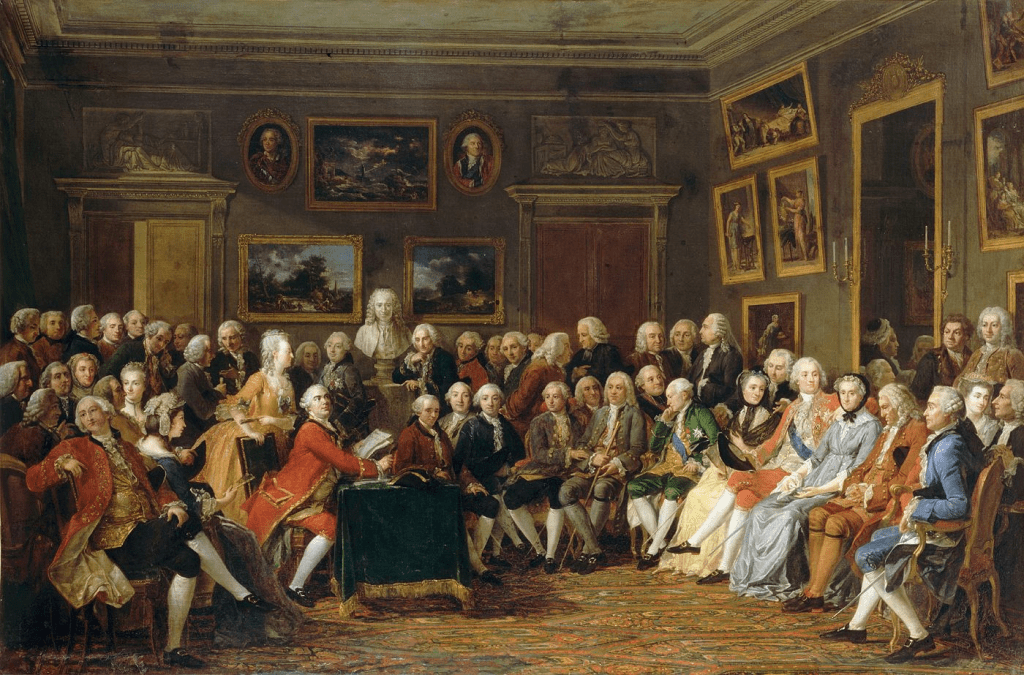
This structural commitment to a secular state was the direct byproduct of the European Enlightenment, an intellectual movement that fundamentally shifted the source of political authority from divine right to logic and reason. The Founders were disciples of thinkers like John Locke, Voltaire, and Montesquieu, and Kandiaronk who argued that governments are created via a social contract among humans, rather than mandated by God through kings or clergy.
Kandiaronk is a lesser known figure of the Enlightment Era. He was a chief of the Huron tribe who frequently interacted with the French colonists in the area. He was a frequent guest and supper debater with the Governor of Montreal, Hector de Callière, and he traveled on a diplomatic mission to Paris, where he attracted great interest in the salons. The Jesuit historian, Pierre François Xavier de Charlevoix, remarked that no Indian had ever possessed a greater mind or greater merit. Kondiaronk’s orations, transcriptions and translations became heavily debated topics of philosophy, especially with Montesquieu.

These men had watched centuries of bloody state and church sponsored wars tear Europe and society apart, the revolutionary generation recognized that the only way to preserve both civil peace and individual liberty was to strip the state of theological authority. By viewing governance through this secular lens, they crafted a system where laws were derived from human utility and the consent of the governed, ensuring that the state remained blind to sectarian differences so that no single religious faction could ever hijack the apparatus of law enforcement to oppress others.
Was the USA founded on Judeo-Christian Values?
Proponents of the “Christian nation” narrative argue that while the structural mechanics of the Constitution borrow from classical republics, the moral philosophy animating the American founding was fundamentally saturated in a Judeo-Christian worldview. They contend that the foundational concept of unalienable rights, as articulated in the Declaration of Independence, is explicitly predicated on the theological premise that human dignity is a gift endowed by a “Creator,” a notion deeply rooted in the biblical concept that man was made in God’s image. Historians subscribing to this worldview point out that the vast majority of early American colonists were deeply religious, and that local colonial charters, state constitutions, and common law traditions were explicitly built upon biblical morality. From this perspective, even the secular emphasis on checks and balances reflects a fundamentally biblical aspect regarding the inherently sinful nature of human beings, suggesting that the Founding Fathers built a secular government on top of a deeply rooted Judeo-Christian moral foundation.

To argue against this, it is crucial to recognize that much of the legal bedrock of the United States was deliberately anchored in secular, classical philosophy and British common law rather than Judeo-Christian values. The structural architecture of the American government: separation of powers, checks and balances, and a representative republic, all are inspired by democratic Athens and the Roman Republic, not the monarchical or theocratic governance structures found in the Old and New Testaments. In fact, key tenets of traditional Judeo-Christian theology directly clash with American constitutional rights. The biblical First Commandment demands the absolute worship of one God stands in diametric opposition to the First Amendment’s guarantee of religious freedom, which legally protects the right to worship any god, or no god at all. Furthermore, the concept of inherited sin and absolute, unquestioned obedience to a divine sovereign stands entirely at odds with Enlightenment era concept of natural rights and the right of the people to alter or abolish an unjust government. By design, the Founding Fathers did not construct a system inspired by religious teachings, but rather an unprecedented, rationalist legal framework intended to remain entirely neutral on matters of cosmic divinity.
Facts Versus Fiction
Ultimately, the gulf between the secular humanism of the American founding and the ambitions of modern Christian Nationalist theologians represents a fundamental battle over the nature of the American experiment. While some modern theologians preach a regressive return to an imagined, homogeneous Christian past where civil laws double as biblical discipleship, it is clear that the founders who actually built the country envisioned a system built on rationale and civic rights in order to protect people of all faiths, or right to worship no faith at all. Trading the pluralistic blueprint of 1787 for a system of state-enforced religious supremacy doesn’t reclaim America’s heritage; it actively dismantles it. As this friction continues to play out in school boards, state capitals, and courtrooms across the country, the true test of modern America will be whether it can preserve a neutral public square that gives religious tyranny no sanction, or if it will allow a single religious interpretation to rewrite the rules of a free society.


Leave a Reply